The Last of the Survivors: Mary Frances, born 1918, died in 2014
Mary Frances, born 1918, was the eldest survivor of the fourteen children of Marie Blanche and Charlie Gaudet. As the eldest child in an ever-expanding family, many responsibilities were thrust upon her.
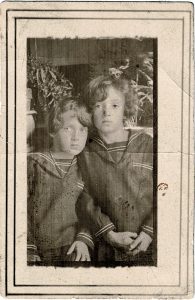
There is only one photograph of Frances in her childhood dating from the earliest years, and with her in the photo is her beloved sister Elise.
Education
Around 1925 Frances was sent a short distance up the road to be educated by the Sisters of Notre Dame at the great brick convent of that name built in 1868.
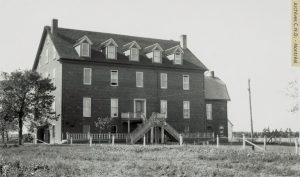
Convent of Our Lady of the Angels, CND – Tignish, PEI
Her time there was brief and brutal. The family could not afford to dress Frances in the manner desired by the nuns, and she suffered for it. Physical and verbal abuse were the order of the day and many of the sisters delivered instruction laced with frequent slaps across the face. Her attendance was spasmodic, not encouraged by her almost-illiterate parents, and so Frances was not a star student. She did learn to read, write, and calculate. Around 1930, having possibly achieved Grade 4, she was deemed fit to go out and earn her living. She was then about 12 years old.
1930, at the age of 12, Frances enters the work force.
Probably because the great local entrepreneur Clarence Morrissey was a neighbour of her grandfather, Joseph Isidore Gaudet, arrangements were made for Frances to go and work in his huge fish factory at the Black Marsh near North Cape. She would have joined a number of other small boys and girls employed in small easy tasks until they grew older and could accept more responsibility. They lived in dormitories and slept on straw and were fed leftovers in the kitchens. Frances would have rarely gone home during this time as the Black Marsh is about 9 miles from Tignish. Sometimes she walked home, along the dirt roads and through the fields.
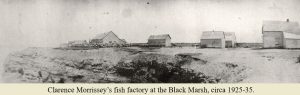
The Undocumented 1930s
The chronology of these years is very vague. Frances was reluctant to talk about those times as the memories were too painful. It is difficult to recreate the ten or so years from leaving school to moving to Halifax to work during the years of World War II. As far as I can make out, they were years of slavery, physical and sexual abuse, a time completely devoid of love and affection. No child in the village could have had a worst time.
The Tignish Run
Probably because her father fished for the Myrick enterprise at the Tignish Run Frances stopped working at the Black Marsh and joined the other children working for the Myricks in their fish factory.
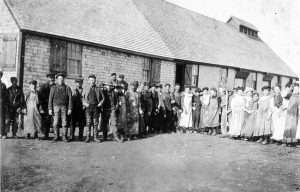
The Myrick Fish Factory at the Tignish Run, circa 1915-20.
The trip home through the woodland paths was filled with menacing terrors. The local boys hid in the woods to frighten her. As they got older their attention turned from teasing and name calling to sexual advances. Inevitably a particularly unpleasant and violent boy raped her and this resulted in pregnancy.
Frances enters domestic service.
It is difficult to recreate these years in Frances’ life. In those days when Catholic girls became pregnant they were taken in by the nuns at the convent and spent their confinement being trained as housekeepers. When born, the baby would be given away for adoption. This appears to be what happened to Frances and she spent time at the CND convents in Tignish and Miscouche. She had good stories to tell about a couple of the nuns who were kind to her. When the child was born she had to leave the convent and in some way unknown to me was employed as a housemaid by the Holman family in Summerside. The Holmans were very prominent and had large department stores in both Summerside and Charlottetown.
Her time working for the Holmans was pleasant because, she recalled, for the first time ever she was treated as a human being by her civilised and cultivated employers. Frances remembers Mr. Holman putting her on the train to Tignish one Christmas, laden with food and small presents. She never forgot this first great kindness in her life, and in her old age we made a pilgrimage to Summerside to stand in front of the Holman house where she was first recognised as a human being worthy of kindness instead of endless blame and guilt.
In the late 1930s Frances moved to Charlottetown where she became a servant to a Mrs. White who was extremely kind to her, fed her well and dressed her, and in her solitude, sought companionship with her.
Wartime in Halifax
When World War II broke out Frances who was now 21, had emerged from a home life of abuse and neglect, survived the child labour of the fish factories, the sexual violence of savage boys, and gained a newfound dignity in domestic service. She was ready to move on and the War provided a means of escape and self-determination as an independent adult.
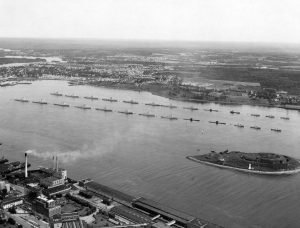
The War brought a huge amount of employment opportunities in Halifax whose port was one of the great military bases of the region. In what seems like no time at all Frances, joined by her younger sister May, and other girls from Tignish who had been friends and neighbours, was employed in a pharmacy that also had a restaurant. It was a very popular spot for hundreds of sailors whose ships docked in the harbour and who went looking for amusement.
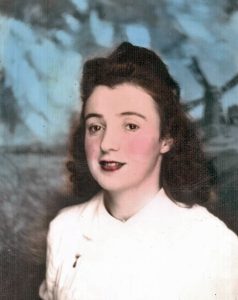
In the drugstore/restaurant there was one of those photographic machines, popular at the time where, after you dropped a coin in a slot and sat in the cubicle, a strip of black and white pictures, still smelling of developer chemicals, would drop town into an outside receptacle. If you cared these little black and white photos could be coloured by hand while you waited. Both Frances and May were taught how to colour the photos and over time, they accumulated dozens, of themselves and their sailor friends. It seems as if there were very happy moments, and this photo of Frances, the first since the one with her sister Elise from the early 1920s, shows an attractive Frances, photographed against an improbable Dutch background.
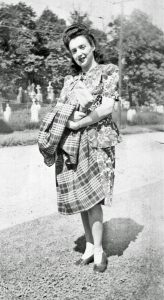
Her hair is long and piled up on top of her head in the style of the day. The hair would get longer and higher in the early 1940s. After Frances died, I found this photo of her very fashionably dressed, and with a great victory roll, which is what those enormous rolls of hair that framed the face were called. I expect this was taken in Halifax around 1942. She is looking stylish and poised.
Frances meets Jimmy Porter
One of the sailors that Frances met was a young fellow from Montreal called James MacKenzie Porter, of Scottish Presbyterian origins. He was a year older than Frances, having been born in 1917.
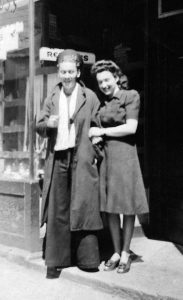
Jimmy Porter and Frances, Halifax, 1942.
He was handsome, musical, and deadly charming and Frances fell in love. Miraculously a photograph of the pair has survived, standing in front of the pharmacy where Frances worked. Her victory rolls are taller than ever in her state of triumph. This is the first time that she was in love and had, so it appeared, a real boyfriend who cared for her. Soon she became pregnant, and he quickly dropped her. He had every reason to. He was engaged to an upper-class girl from Saint John, and on November 30, exactly one week after I was born, they married in splendour.
A son is born.
We can only imagine the pain and grief this caused Frances. When the pregnancy became obvious she returned to the Island and went to live with her godparents, Malvina and Mike Doucette who lived near Kensington. My birth, which took place on November 23, 1943 in the Summerside hospital, was a difficult one as I was born with jaundice. Until I could recover sufficiently, Frances lived with her godparents. By March 1944 I was sufficiently recovered to be able to travel and all three got on the train and took me to her parents, Charlie and Marie Blanche, in Tignish. I was baptised as James Reginald Porter, with Malvina and Mike as my godparents, and then I was left with Marie Blanche and Charlie. A story was spread about the village was that Frances’ husband’s ship had gone down and he had drowned. The widow left her child with her parents while she went back to work to earn money to support the family. And that is what she did. She returned to Halifax for the rest of the war.
Frances’ younger sister Susan, who was fifteen at the time, and passionate about cats, dolls and dancing, became my surrogate mother. She was extremely kind to me, treating me, I believe, like one of her beloved cats. Marie Blanche, having just the year before lost the ninth of her fourteen children, could not cope.
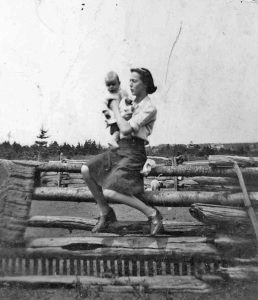
Susan with Reggie, summer, 1944.
After the war employment in Halifax dried up and Frances, her sister May and several of the Tignish girls went to Moncton where they got jobs in Eaton’s Department Store. It was soon time for Susan to grow up and start earning a living and she too moved to Moncton. Marie Blanche had to take over caring for me but by that time I could crawl, and have vivid memories of exploring the space under the kitchen table where my grandfather’s friends played cards every night except Sunday. I crawled under the table to be close to people and remember being surrounded by boots that smelled of horse shit.
In the summer of 1948 or ’49 Susan came home for a joyous visit and I was in transports of joy. It was so good to see her again. But then something terrible happened. She simply collapsed in front of the house where she was playing with me. I could not understand what was happening. She was taken to Alberton, then to Summerside, and then to the Tuberculosis Sanitarium in Moncton. She had been stricken by tubercular meningitis of the brain and spine.
She was expected to die, so severe was her illness. The family agreed to allow the doctors to experiment with the new miracle drugs, Streptomycin and Aureomycin. She was pumped full of these drugs and they saved her life, but in the process causing her to become almost deaf and arresting her emotional development.
Frances cared deeply about Susan, the surrogate mother of her child, and she visited her often in the hospital. I found this photo among her papers after she died.
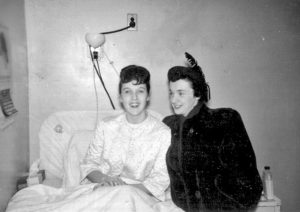
Frances visits Susan in the Moncton Sanitarium
The Trip to Moncton.
Frances decided that since Susan might not live her mother should come from Tignish to see her. Marie Blanche and I boarded the bus very early one morning and headed for Moncton. I was terrified of motor vehicles, knowing and loving only horses, so the trip was a great stress. We stayed in the basement apartment where the Tignish girls lived on Botsford Street and I was reunited with my mother, who seemed glad to see me. An affectionate photo survives.
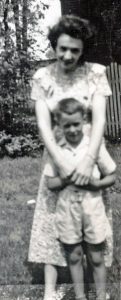
Frances and Reggie, Moncton, 1949.
My mother did not really know me, having only had one week of contact with me per year since I was born when she came to Tignish for her annual vacation. In the basement where their apartment was located, she found a boy’s wagon and a large teddy bear – the biggest I had ever seen! These were brought outside and aired and I was allowed to play with them and to be photographed. Of course, I fell in love and wanted them. My snivelling exasperated Frances so much that she slapped me, no doubt exactly as her mother had slapped her. I was photographed again, shortly after the slap and the tears, and the photo tells the whole story of our subsequent relationship.
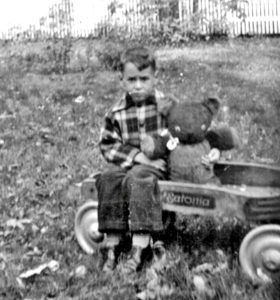
Reggie. Moncton, 1949.
The Montreal Years.
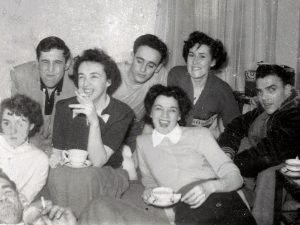
By the early 1950s Susan recovered sufficiently to be discharged from hospital. She went home to Tignish to stay with her mother. Frances and May, along with their old friends from Tignish moved on to Montreal. May went on to a lengthy career at Eaton’s, working all those years in the belt and glove department. A number of other people from Tignish also lived and worked in Montreal at this time and there would be happy weekend gatherings.
The Credit Bureau of Montreal Years
Quite early on Frances got a job at The Credit Bureau of Montreal where she worked for many years as a credit investigator, spending her days on the phone gathering and analysing data from credit applicants. She was very good at her job and while kindly appreciated by her various bosses she was harassed for years by one of her supervisors. As the years went on this brought great misery into her life and she had to live with the knowledge that this state of things would go on for a long time until she reached retirement age.
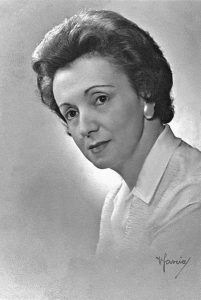
Employee photo of Frances taken at The Credit Bureau for their annual report.

Frances loved to dress and had good taste in clothes.
August 1958 – Her son Reggie finally comes to live with Frances.
By the time I was 14 my grandparents had had enough of me and wanted me to go. I too desperately wanted to leave because of the years of physical and verbal abuse in a home and a community where I was not wanted.
In August of 1958 I packed my books and scientific specimens and descended on my mother and May in Montreal. It was a wildly exciting time.
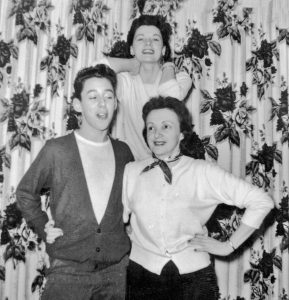
Reggie with Frances and May, circa 1959 or ’60.
With her modest income Frances performed miracles to pay for the huge additional expense of having me around. I was always well-dressed and well-fed and welcomed into the family and the milieu of their Montreal friends.

Frances and May with their Montreal friends.
Life went on, often unhappily for us all, while I did my four years of high school and then began my studies at Loyola College. All that is another story which I will tell in another blog entry. Finally when I was 18 I left home and got a job. Frances moved to a smaller flat and I believe lived a contented and comfortable life for the first time ever.
The Birth of Larry
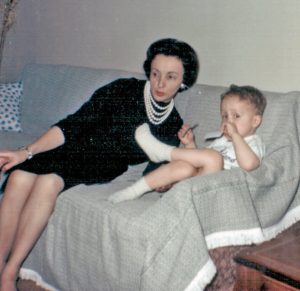
The birth of Frances’ nephew, Lawrence “Larry” to her brother Gerard and his wife Vera, was to be a great event in her life. Not having had any experience at all in bringing me up and loving a child, she devoted all her spare time to babysitting and introducing Larry to fascinating things in his environment.
The Cottage at Anglo Shore
As she got older, and with money carefully saved, thoughts of retirement began to obsess Frances. She had decided to take an early retirement and go back to spend the rest of her life in Tignish. Energetically she set about finding a small building she could afford and had it moved to the edge of the sea on her sister May’s large lot at Anglo Tignish. Little by little she turned this scruffy building, inside and out, into a very comfortable cottage where she could live year-round.

May lived very close by in a large new house built after her husband Fred died.
There were very pleasant family gatherings at May’s grand house and some lovely photographs of those five survivors of Charles and Marie Blanche’s huge family survive. It was a pleasant time where memories of their destitute origins were suppressed and only happy things were talked about.
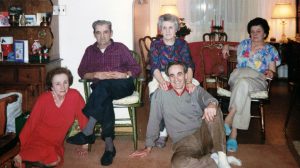
The Garden Years
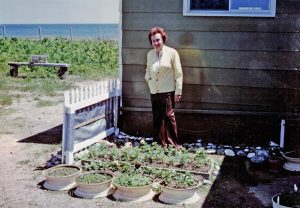
Frances took up gardening at her cottage and experimented with different beds and containers. She was very proud and happy at her new skill.
During those years I would visit my mother regularly, especially at birthday time and Christmas. From time to time, I drove down with friends to show them where life began for me. One such visit was in the summer of 1983 when this photo was taken. Physical affection had never been part of life with my mother and it is a good thing that this very rare example was recorded on that day.

Reg and Frances at Anglo, Summer 1983.
Age and Poor Health Cause Frances to Move to Town
In her early 80s Frances began to experience various health problems, one of them requiring complicated heart surgery. Life in isolated Anglo became a source of anxiety and she decided to rent a small flat at the Davis Lodge in Tignish. It was close to the church and only a ten-minute walk from the stores and her doctor.
She spent a great deal of time decorating her little flat with her many favourite pictures of members of the family but also with her ever-growing collection of books. She was an enthusiastic fan of L M Montgomery and in these years at the shore and in town I was able to give her the complete stories of Anne of Green Gables which she prized greatly. In her last years she had about 200 books in her collection, many of them the works of Canadian writers like Margaret Atwood, Farley Mowat, Lenard Cohen, Antonine Maillet and Mordecai Richler. She was fluent in both French and English.
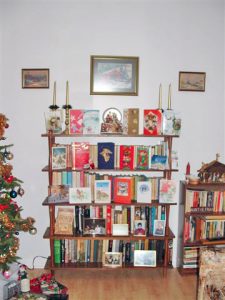
Christmas 2007
A Long Life filled with Love, Generosity and Never-Endling Sacrifice
Frances lived to be 96 and was absolutely determined to live to 100! Her love of life – in spite of the many severe traumas that punctuated it – was intense. She had a wicked sense of humour, as they say in Tignish, and was always ready to see the funny side of things, no matter how difficult things were. It was always get up and move on.
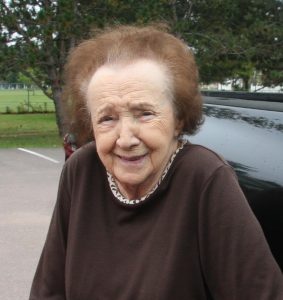
Her last picture – October 2, 2011
Frances was my mother but we were never close. I wanted evidence of her love and she wanted me to go to the top. In between were uncountable fights and long periods of silence.
But my gratitude to her is undying. She instilled in me the cautious attitude to the world which has guided the decisions of my life, and she reigns supreme as an example of a woman filled with love and loyalty, who overcame every obstacle to be there for the ones she loved.